Why Harmonised Assessments are the Key to Climate Action in the Food System


- Up to 95% of food emissions sit in Scope 3, making secondary industry averages insufficient for Science-Based Targets.
- Varying LCA methods, databases, and system boundaries create fragmented data that prevents confident corporate reporting.
- Foodsteps’ automated process harmonises supplier data across functional units, allocation rules, and GHG Protocol standards.
- Data harmonisation removes reporting friction for suppliers while delivering audit-ready inventories for downstream buyers.
Food businesses’ ability to drive real and reportable decarbonisation is fundamentally tied to the quality of their Scope 3 data. Up to 95% of a business’s emissions come from Scope 3 Category 1: Purchased goods and services. This means that relying on secondary industry average data for activities in the supply chain is no longer a viable strategy for companies trying to move from climate pledges to actual impact reduction. To drive meaningful reductions and track progress against Science-Based Targets it is essential that businesses transition to primary, supplier-specific data in their impact reporting.
Integrating this data into a corporate emissions inventory, however, comes with its own set of challenges. The current product footprinting landscape is highly fragmented, with suppliers often using different LCA tools, conflicting system boundaries, and differing emission factor databases to generate their product footprints. This means that two seemingly identical products can have significantly different footprints simply because of the methodology used to generate their results.
Furthermore, the goals of the original assessment may not align with those of downstream buyers, leading to a mismatch in components such as the assessment system boundary. Without a rigorous process to align these inputs, a corporate emissions inventory can become a collection of incompatible data points, preventing development of a reliable decision-making tool for decarbonisation.
Product footprint harmonisation of fragmented supplier data is a fundamental building block of an audit-ready, actionable Scope 3 inventory.
What is Harmonisation?
Harmonisation is the process of standardising the results of a product footprint to a common methodology. Because common LCA standards often provide flexible guidance in place of a standard set of rules, a product’s footprint can be as much a reflection of methodology choices or access to data as it is of operational reality. This can be seen in the selection of a system boundary, where one supplier may only report impacts from farm operations, while another includes processing and transport stages.
The same can be seen in the selection of allocation methodology, where one supplier might allocate impacts based on the biophysical relationship between co-products and their inputs, while another might do so on the basis of relative economic value of the outputs. Harmonisation interrogates and adjusts these decisions such that product footprints, and the rest of the data points in a given corporate inventory, are as consistent as possible.

Why Harmonisation Matters
The data burden on food businesses in the drive towards a Net Zero food system affects the whole value chain. Foodsteps employs harmonisation in order to benefit both downstream and upstream businesses in efficient and clear data collection and transfer.
Identifying What Good Looks Like
A more sustainable food system is urgently needed. While we do have data on the environmental impacts of production from some farms and food producers, the data tends to be incomparable due to different tools being used, with a lack of a consistent data format or methodology. This means that significant uncertainty remains as to what sustainable food production looks like, and how we should best advocate for it in the food system. Ultimately, this holds up decarbonisation by preventing confident decision-making.
To solve this challenge at scale, our research has contributed to the HESTIA data platform which provides harmonised open access data, contributed to by food system researchers worldwide. This data facilitates quicker progress and clearer answers in research, business operations, and policymaking.
Enabling Progress in Supply Chain Decarbonisation
For downstream sustainability teams, primary supplier data is required to identify and drive decarbonisation in their supply base. If the data supporting decarbonisation measurement and decision-making isn’t harmonised, a reported reduction in emissions might simply be the result of a supplier changing their footprint methodology rather than a real-world improvement in practice. At present, methodological variation typically drives greater variability in calculated footprints than the scale of change seen due to practice changes, from one year to the next. Without harmonisation, this data won’t stand up to scrutiny when reported as the basis of Scope 3 emissions reductions.
Harmonisation also enables genuine comparison between primary supplier data and secondary emission factors, allowing downstream businesses to identify those suppliers working to reduce their emissions and reflect real reductions in their corporate inventories relative to average production benchmarks. Harmonising supplier data enables effort spent on supplier engagement to truly deliver value for businesses seeking to understand the impact of their supply chain, and show progress in reducing those impacts.
Reducing the Reporting Burden for Suppliers
Suppliers are being asked for sustainability data by many of their customers, often with slightly different requirements. This can create massive time and resource bottlenecks for suppliers to respond to, distracting from the real work required to decarbonise their operations while producing the food we need to eat. At Foodsteps, our approach is designed to shift this burden by taking the work suppliers have already done and harmonising it on our end. In doing so, Foodsteps ensures that their existing footprints are fit-for-purpose for their customers without requiring them to dig into the weeds of their own footprint methodologies for every request. Harmonising the data to a consistent format will allow this data to flow through the system much easier.
How We Do It: The Foodsteps Harmonisation Process
Foodsteps’ harmonisation process is informed by leading global reporting standards, including the relevant GHG Protocol standards such as the recently released Land Sector and Removals Standard (LSRS), and sector-specific guidance such as the WRAP Scope 3 Protocols and the LED 4 Food product methodology recommendations. When supplier data is entered into Foodsteps Supplier Hub, it undergoes a rigorous harmonisation process before it is ready to be used within a Scope 3 assessment.
1. Aligning Units and Emission Factors
First, we ensure the results and supporting emissions modelling of the footprint are standardised. This standardisation involves:
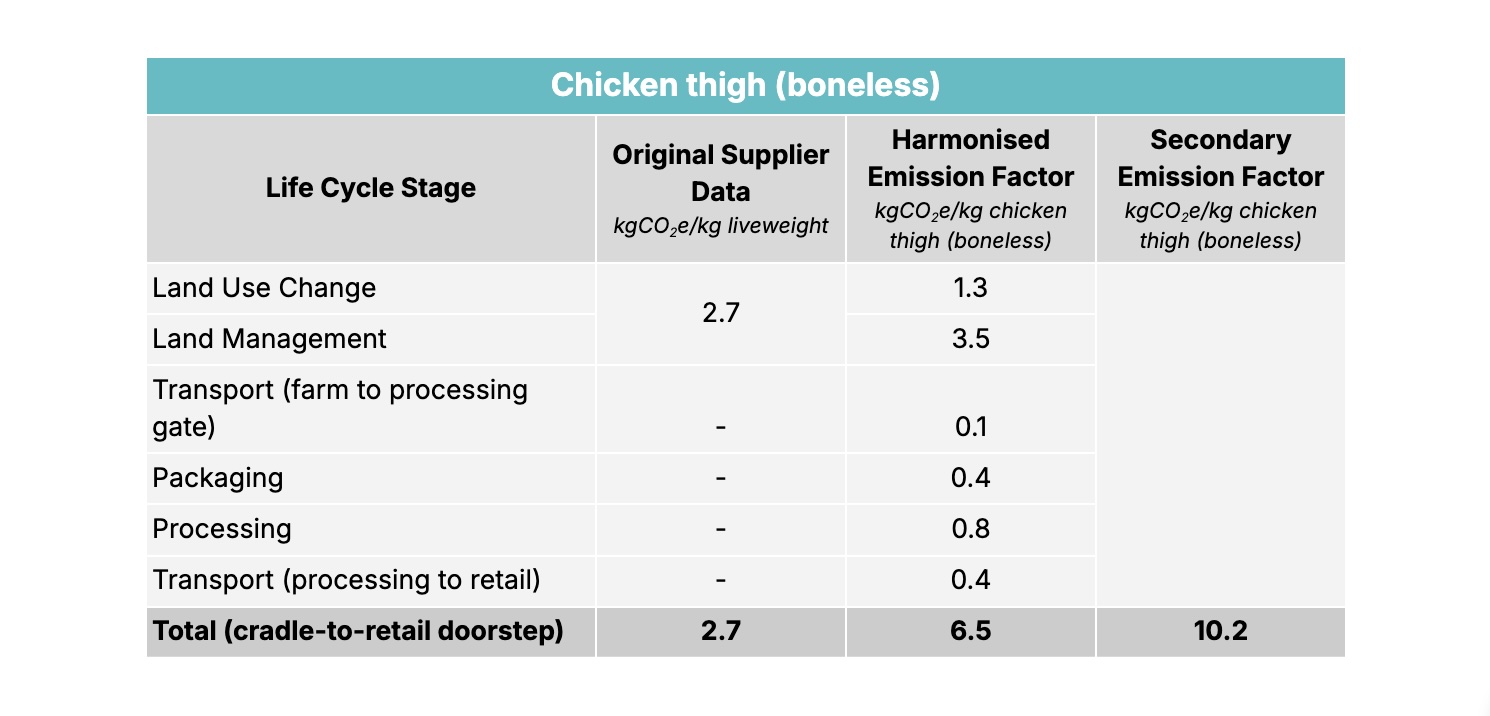
- Functional Unit Conversion: Aligning results to a common unit (kg of CO2 equivalents per kg of product procured) as required by the use case. This can be as simple as converting between litres and kilograms using a product density, and as complex as allocating impacts per kilogram of animal liveweight to actual output meat products purchased by a downstream business. Standardising the functional unit ensures that the results of a product footprint are in the same units as the lines of procurement data that they’ll be matched to in a Scope 3 assessment.
- IPCC Alignment: Updating global warming potential (GWP) values used within background emission factors to ensure that they are consistent. Doing so ensures the direct comparability of different assessments.
2. Aligning Methodology Choices
This is where we dive deeper into how a product footprint was modelled. If a supplier’s footprint uses a methodology that diverges from the requirements of the Foodsteps Methodology, we adjust the footprint to ensure alignment. Key actions here include:
- Economic Allocation: We standardise the way impacts are shared across co-products of a given process, such as those within meat and milk production, by applying a detailed economic allocation method. Because the choice of allocation method (e.g., economic vs. biophysical) is often the single biggest driver of footprint variance between similar products, consistency is vital for true consistency across supplier footprints, as well as primary and secondary data. By aligning with the LED 4 Food product methodology recommendations for allocation, we ensure that all footprints used in Scope 3 assessments follow a rigorous, industry-recognised standard that reflects the actual drivers of decision-making in the food system.
- Packaging Methodology: Foodsteps converts packaging impacts to the cut-off method and removes end of life impacts if they are aggregated into the reported packaging footprint, as they must be reported separately. The cut-off method assigns the environmental impacts of packaging material production to the initial user, and the potential benefits of recycling at end-of-life to the subsequent user of that recycled material.
- Land Sector and Removals Standard (LSRS) Compliance: We review the methodology used to ensure that it is aligned with the requirements of the LSRS. If it is not, then we remove or replace relevant impacts with our secondary data, such as our LSRS-aligned modelling for land-use change emissions of different products. This ensures the data is reporting-ready and scientifically robust.
3. Gap-Filling: Completing the Picture
Suppliers sometimes have gaps in their product footprints that mean they aren’t ready for use in Scope 3 reporting of other value chain stakeholders. This can include the exclusion of certain material inputs to their production system, as they are outside of the original assessment scope, or assessing only the impact of processes within their operational control. Gap-filling ensures that all relevant inputs and processes are included in a product footprint that will be used by a downstream reporting stakeholder. For example, if a customer requires cradle-to-processing gate data for their Scope 3 reporting, but the supplier only assessed the impact of on-farm production, Foodsteps fills that gap using high-quality secondary data to ensure the boundary meets the downstream customer's reporting needs.
4. Disaggregation: Preparing for Reporting
The GHG Protocol Land Sector and Removals Standard (LSRS) and Science Based Targets initiative FLAG (Forest, Land, and Agriculture) requirements both mandate that businesses must report land-based emissions disaggregated into constituent greenhouse gases, and report these emissions separately from energy and industrial emissions – although the exact categories differ slightly. The final step in our harmonisation is thus to disaggregate results into specific reporting categories and greenhouse gases. Disaggregation and granular reporting supports interoperability, and ensures that product footprint results are available at the necessary level of granular detail needed to support complex corporate reporting and target tracking.
.avif)
Towards Automated Harmonisation
Harmonisation of primary product footprints for use in Scope 3 assessments has historically been a manual, labour intensive process that is slow, expensive and difficult to scale beyond a small group of products. At Foodsteps, we have already automated large parts of our harmonisation process within our platform in order to ensure that robust Scope 3 data doesn’t come at the expense of scaling impact, with appropriate human in-the-loop stages to maintain robust outputs.
Throughout 2026, we are continuing to build further automation to make supplier data integration into Scope 3 assessments seamless. Our goal is to make high-quality, harmonised primary data at scale the standard, not the exception, and empower food businesses to stop questioning their data and start confidently reducing their footprint.
The Limits of Harmonisation
At present, there is a huge focus on ensuring harmonised environmental impact assessments are conducted and used for reporting at scale as shown by initiatives like GSTA, which aims to establish a standardised methodology for food product assessments. Given this focus, it is worth taking the time to collectively establish what we seek to achieve with standardisation. Standardisation must serve as a quality floor, not a ceiling. We must ensure it doesn't become a default limit for less ambitious businesses, nor an unintended barrier for those striving to deliver assessments well above the minimum bar.
At Foodsteps, we are concerned that an overly prescriptive attempt to standardise methodologies and data sources risks sacrificing accuracy and therefore assessment utility for the sake of standardisation. This may prevent high quality assessments of sufficient granularity to inform and enable the rapid and substantial decarbonisation required of the food system. Conversely, it may also lock out other businesses from streamlined, affordable assessments that match their decision-making needs or technical capacity.
Ultimately, standardised assessments should accelerate decarbonisation rather than become a barrier to it. We must define limits that ensure high quality data while leaving room for the optionality businesses need to solve their unique problems. Striking this balance ensures that assessments stay practical, inclusive, and effective in driving real-world change.
.png)