ECGT Is Here: How Food Businesses Can Navigate the EU’s Greenwashing Rules

- ECGT protects consumers from greenwashing and unsubstantiated or misleading environmental claims.
- In effect from September 2026, ECGT impacts any business selling or marketing to the EU – regardless of where they are based.
- With up to 90% of a food business's environmental impact sitting in the farm and processing stages, verifiable and granular lifecycle data has never been more important.
- Working with a solutions provider to calculate your Product Carbon Footprint not only protects you from fines and public backlash, but positions you as a leader in the sector.
What is the ECGT Directive?
The Empowering Consumers for the Green Transition (ECGT) Directive is designed to eradicate greenwashing and protect consumers from misleading environmental claims.
The directive establishes strict legal bounds for business-to-consumer (B2C) sustainability claims with a simple core requirement: every environmental claim made to consumers must be substantiated with verified, objective, and full-lifecycle evidence.
Non-compliance can lead to regulatory penalties – including fines of up to 4% of a company's annual turnover – and product recalls. This is to say nothing of the reputational damage and loss of trust a brand might also face.
Who Is Impacted by ECGT?
A common misconception is that ECGT only applies to companies headquartered within the European Union. In reality, ECGT impacts any business selling, distributing, or marketing food and drink products within the EU market – regardless of where the business or its supply chain is based.
Whether you're a UK-based food manufacturer exporting products to Europe, a global brand selling packaged goods in EU supermarkets, or an international business promoting products online to European buyers, your B2C communications sit firmly within these regulations.
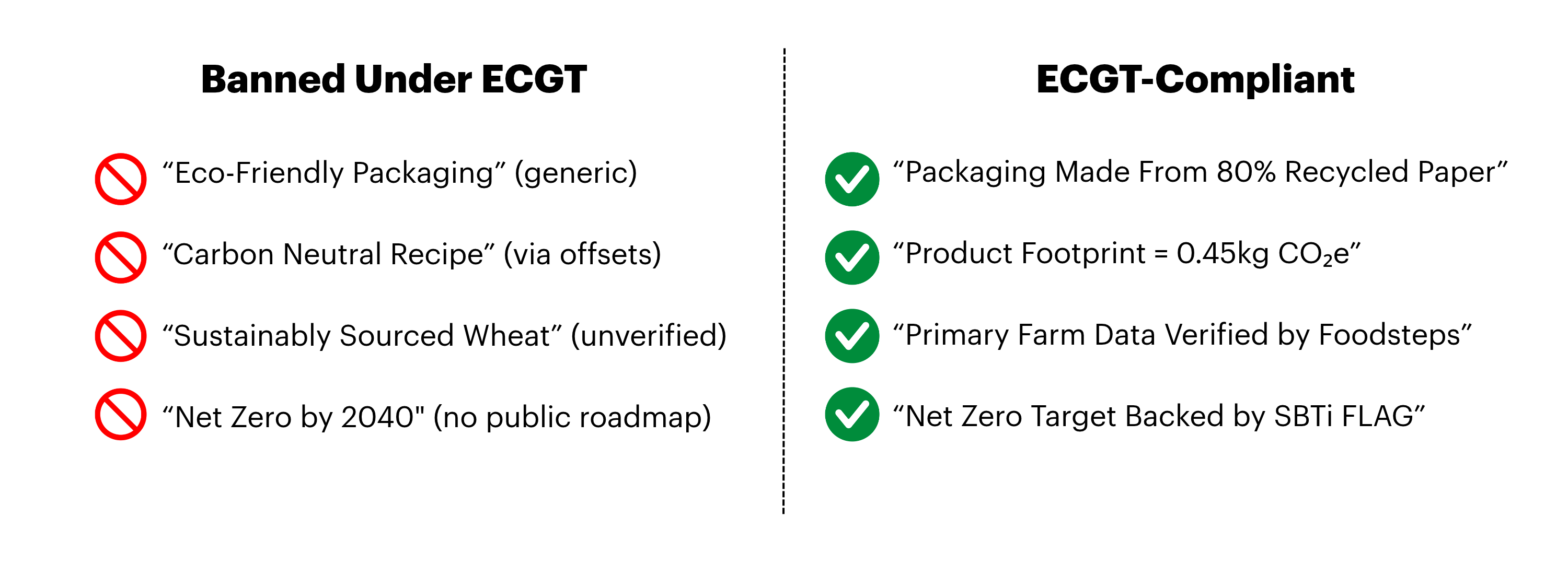
4 Environmental Claims That Are Banned Under ECGT
❌ Generic Environmental Claims: Broad, unspecified terms like "eco-friendly", "green", "climate-friendly", or "sustainable" are prohibited unless back by official "excellent environmental performance" (such as the official EU ecolabel or an ISO 14024 Type 1 certification).
❌ Product Neutrality Via Offsets: Claiming that a food item is "carbon neutral", "net zero", or "climate positive" due to the purchase of external carbon credits outside the product's value chain is explicitly banned. Claims like these must reflect real emissions reductions within the product's supply chain.
❌ Unverified or Self-Created Sustainability Labels: Displaying self-awarded "green" logos, internal seals of approval, or unverified sustainability marks is no longer permitted. Sustainability labels must stem from an independent certification scheme or be established by a public authority.
❌ Future Promises Without Unverifiable Plans: It is illegal to make forward-looking climate commitments – such as "Net Zero by 2040" or "50% Lower Carbon by 2030" – on product packaging or consumer marketing unless it's accompanied by a concrete, publicly available implementation plan backed by clear milestones and third-party verification.
Why ECGT Matters to Agrifood Businesses
Up to 90% of a food business’s total environmental footprint sits within Scope 3, originating far upstream – at the farm, land-use, and ingredient processing stages.
Historically, many food brands have relied on generic industry averages or spend-based proxies to estimate product footprints. Under ECGT, however, these high-level estimates are not sufficient to back up consumer-facing marketing claims. If a brand advertises a "low-carbon recipe" or "sustainably sourced ingredients", regulators will expect full, audit-ready data that accounts for direct agricultural inputs, land use, and localised sourcing factors.
Without primary, verifiable supply chain data, making environmental claims leaves food brands vulnerable to legal scrutiny and allegations of greenwashing.
How Foodsteps Helps You Turn ECGT Compliance Into a Competitive Edge
Meeting ECGT requirements doesn't mean abandoning sustainability marketing, but it does mean grounding your claims in rock-solid science. Foodsteps provides the data, technology, and scientific infrastructure needed to make your environmental claims compliant and defensible.
1. Audit-Grade Product Footprints (PCFs)
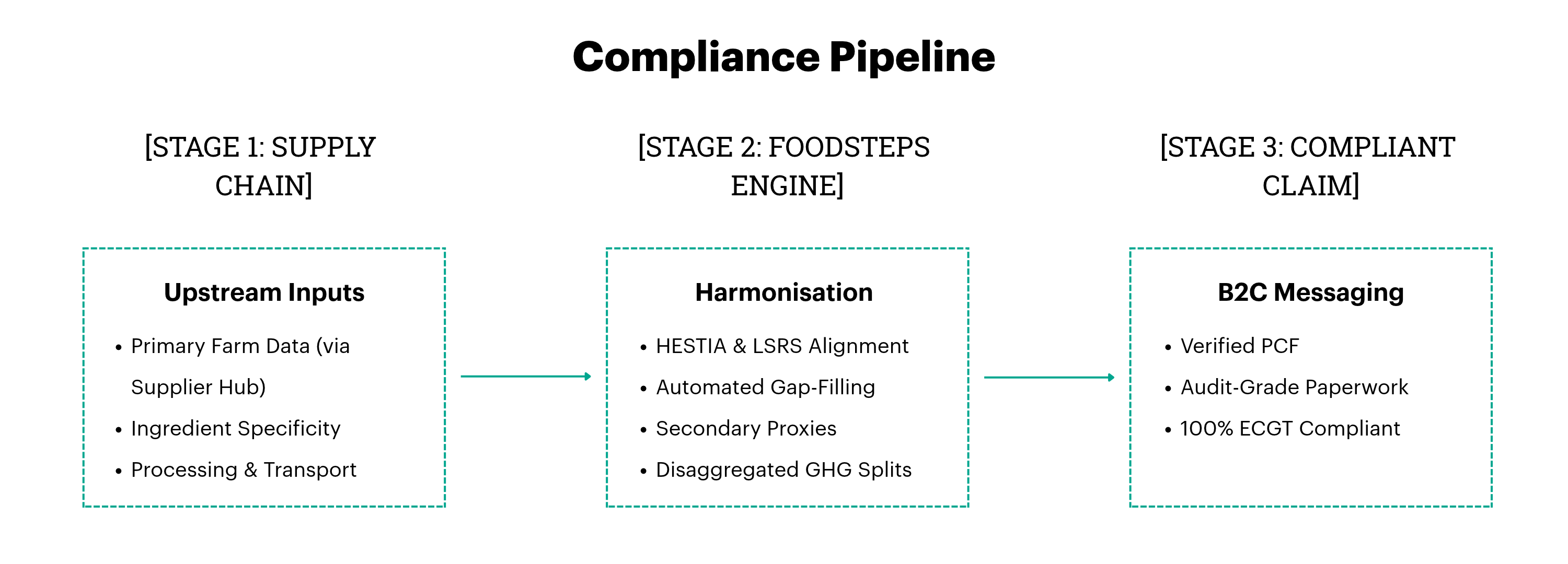
Foodsteps calculates cradle-to-grave Product Carbon Footprints (PCFs) down to individual ingredients, country of origin, and packaging materials. Powered by a database of over 45,000 emission factors built on peer-reviewed scientific studies, our platform generates granular assessments that meet the high bar required by European consumer authorities.
2. Primary Data Via Foodsteps Supplier Hub
Moving away from generic proxies requires direct engagement with your supply chain. The Foodsteps Supplier Hub automates the collection, validation, and harmonisation of primary farm-level and manufacturer data. By replacing secondary assumptions with first-party supplier inputs, you get the verifiable evidence required to prove product-level emissions reductions.
3. Methodological Standardisation & Alignment
To survive regulatory scrutiny, data must align with recognised global standards. Foodsteps ensures your footprint assessments adhere to leading accounting frameworks, including the GHG Protocol Land Sector and Removals Standard (LSRS), WRAP Scope 3 Protocols, and HESTIA data standards. Disaggregated greenhouse gas metrics and transparent methodology logs ensure your claims hold up under independent third-party audits.
Are Your Product Claims Ready for Scrutiny?
The transition from vague slogans to verifiable impact is reshaping the food market. Brands that invest in primary data and transparent footprinting will build deep consumer trust and lead the market in innovation.
Don't wait for fine or backlash to audit your supply chain data.
Book a demo with the Foodsteps team today to discover how our platform can future-proof your business.