The Foodsteps Transport Model: Refining Impact Calculations for Food’s Journey Around the Globe

- The journey food takes around the world to get to its final destination is nuanced – and often not accurately reflected in its calculated impact.
- Foodsteps’ Transport Model is purpose-built for food to reflect a product’s characteristics and sourcing geography.
- The model considers multiple different routes so it can respond to change and open up scenario modelling that is not possible with a static figure.
- In a globalised world where instability can greatly impact supply chains, it is increasingly important to understand your food product's journey.
Transport's Invisible Metrics
Not all food is transported equally.
Some products set sail on the high seas, some are put on a train, and some go by air. Some travel great distances, while others are sent just down the road.
And yet these nuances are often hidden in a product’s carbon footprint.
Ignoring these factors – using averages and assumptions adopted from studies of similar ingredients – paints an incomplete picture of a product’s environmental impact.
As part of Foodsteps’ ongoing efforts to bring more transparency to agricultural supply chains, we created a transport emissions model to more accurately reflect the realities of the food system.
Modelling Transport Emissions For a Global Food System
The Foodsteps Transport Model generates secondary-data emission factors for the transport of food between any two locations. It is calculated in line with the GLEC Framework v3 and the ISO 14083 method (though it has not yet been certified).
The model is purpose-built for food: three tiers of transport urgency capture how perishability drives route and mode choice, and ambient and refrigerated conditions are calculated separately – with transportation, transhipment and refrigerant-leakage components disaggregated. This allows us to produce emission factors that are specific to a food item's characteristics and sourcing geography.
The transport model lets us quantify what-if scenarios, such as how a sourcing decision changes the transport stage of a food item's GHG footprint.
What Is Foodsteps Doing Differently?
Some platforms source transport emissions from published LCA studies of comparable products – inheriting the origin, destination, mode, and distance assumptions that the study used for its specific context.
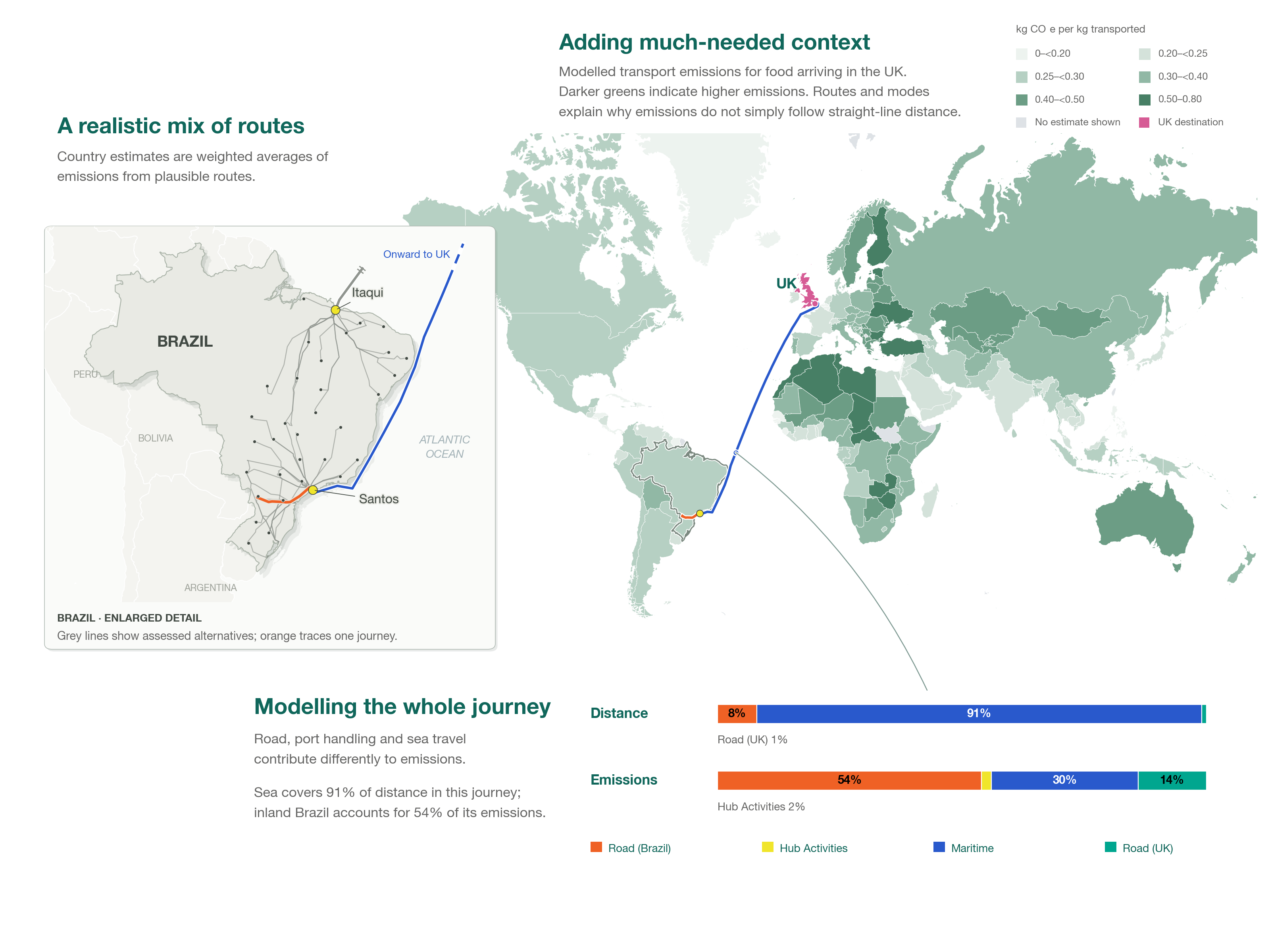
Our transport model gives food businesses control over transport emissions that a fixed figure method can’t offer. Because the factor is built from a consideration of realistic routes, it responds to change – such as choosing a different sourcing country – and opens up scenario modelling that isn’t possible with a single static figure.
Foodsteps Transport Model Inputs
Our model ingests the most relevant data points that influence the carbon emissions for different food products and ingredients as they are transported around the world.
- Real transport networks. Road, rail, ferry and shipping-lane data, plus port and airport locations – so routes follow actual physical paths.
- Where food is grown and where people live. Subnational production and population data, setting realistic origin and destination points within each country.
- Industry-standard emissions intensities. GLEC well-to-wheel factors by mode, region and distance band, plus reference values for refrigerant leakage.
- A route-choice model. For each ingredient or product, plausible routes are identified and assigned a probability based on distance, mode and duration: shorter or faster routes will be favoured for highly perishable products. By using this to weight the final emissions estimate, the model reflects a realistic mix of transport options rather than relying on a single assumed journey.
The Benefits Of Going Beyond Static Numbers
Complex supply chains require tools that can handle the nuances and pace of our globalised food system. Until recently, transport emissions were treated as a static component of product footprints, masked by broad regional averages that obscured both climate risks and decarbonisation opportunities.
Replacing fixed assumptions with dynamic, route-specific modelling not only facilitates accurate carbon accounting, but also provides food businesses the visibility needed to evaluate alternative processing hubs, optimise sourcing strategies, and model real-world disruptions.
Whether seeking purely lower-emission routes, or adapting to shifting trade corridors or geopolitical volatility, granular transport data helps food businesses future-proof their supply chains.