Building the Data Foundation: 5 Years of Partnership with HESTIA

- Foodsteps and Oxford’s HESTIA research group have partnered for 5 years to bring open-access, harmonised environmental data to the food industry.
- The collaboration has expanded data coverage across alternative proteins, livestock systems, and major international crops.
- Key joint outputs include supporting WRAP's Food Environmental Impact Database (FEID) and aligning datasets with the GHG Protocol LSRS.
- Foodsteps integrates HESTIA's bottom-up modelling directly into its platform, giving food businesses granular, audit-ready LCA data.
Scaling corporate and product-level footprinting across the food industry requires a foundation that many businesses currently lack: high-quality, transparent and comparable open-access data. While a vast amount of environmental impact data exists across industry and academia, it is historically fragmented across many sources, stored in inaccessible formats or rendered incomparable due to differing methodologies and data structures. As a result, businesses cannot use this information effectively without spending substantial effort to manually collate and harmonise it.
Without consistent data, food brands cannot reliably baseline their value chain impacts, set verifiable reduction targets and plan reduction initiatives, or confidently report progress to stakeholders.
For the past five years, Foodsteps has partnered with HESTIA – a research group within the Oxford Martin School at the University of Oxford – to address this critical data issue. Together, we have collaborated across multiple research initiatives to scale up HESTIA’s best-in-class environmental impact data, bringing it out of the research space and into practical industry applications that power corporate environmental accounting.
Who is HESTIA and what do they do?
Established in 2019 following the publication of the landmark Poore & Nemecek study in Science, HESTIA was founded by Joseph Poore to scale and democratise the data and environmental modelling underpinning global agricultural research.
HESTIA addresses critical industry data gaps through three core pillars:
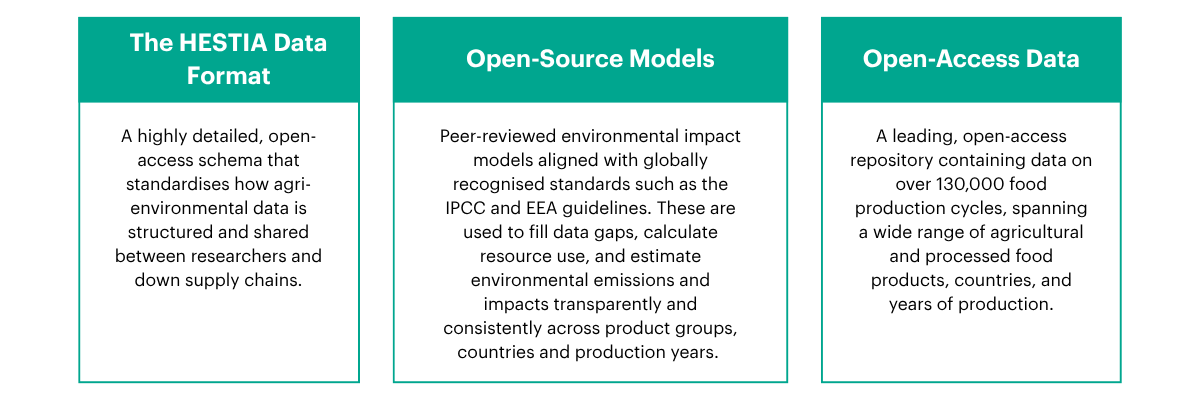
By providing these foundational building blocks, HESTIA enables consumers, producers, businesses, and policymakers to make informed, data-driven decisions on sustainable food production and consumption.
To understand the importance of harmonising the methodologies behind environmental impact modelling in the food system, explore further here.
Learn more about HESTIA's schema, data repository, and models.
Why does Foodsteps partner with HESTIA?
At Foodsteps, our mission relies entirely on good data. To give food businesses confidence in their sustainability assessments, the data we use must be transparent, granular, and trustworthy. HESTIA’s bottom-up approach to building highly detailed impact factors provides a rigorous foundation that complements our own work.
Our partnership operates as a collaborative exchange:
- Contributing Expertise: The Foodsteps in-house Science Team contributes technical expertise to support development of the HESTIA platform. This includes cleaning and uploading complex datasets to HESTIA, as well as collaborating on the development, testing, and refinement of their environmental impact models. In line with our expertise, we have focused our support for HESTIA on both animal and plant-based protein production systems.
- Integrating Best-in-Class Data: In return, Foodsteps gains early access to the latest harmonised data and technical methodologies developed on HESTIA. We integrate these robust datasets directly into our own work, elevating the accuracy of our client assessments and remaining at the forefront of food life-cycle assessment (LCA) science.
Timeline of our work together
Over the last five years, Foodsteps and HESTIA have executed a series of research projects designed to expand and develop HESTIA’s environmental impact database and models, alongside other key research and policy partners.
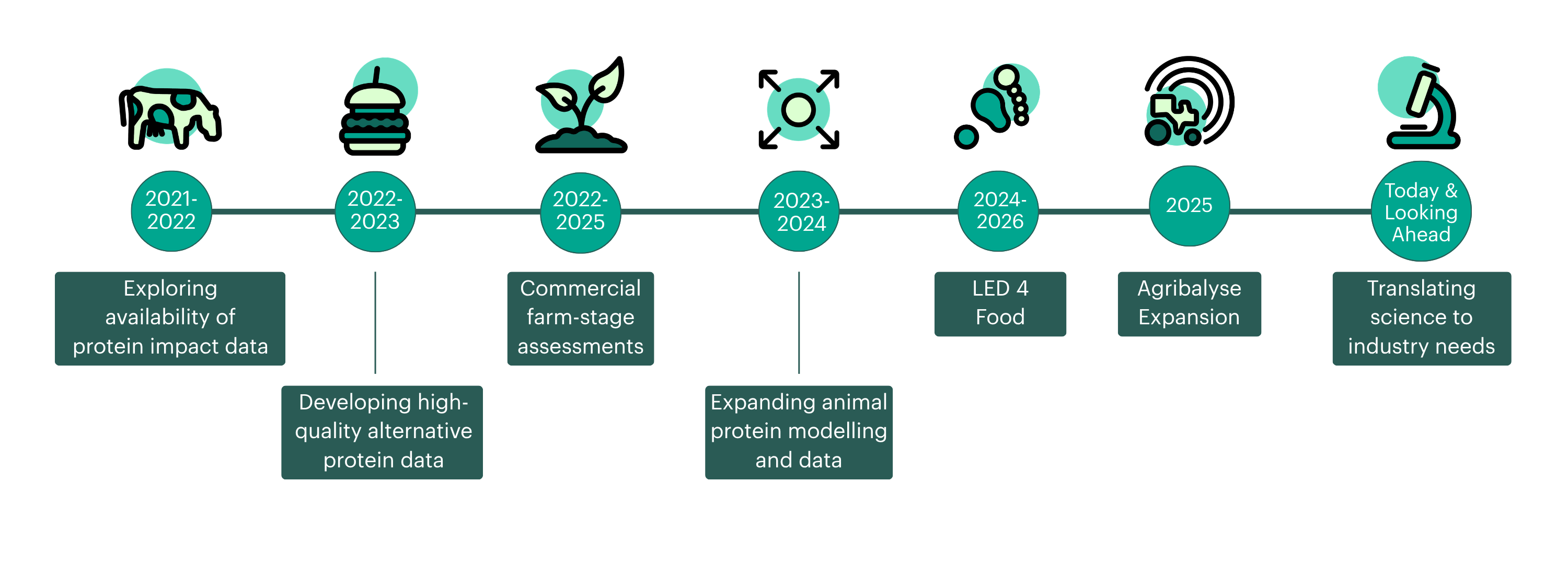
August 2021-2022 | Exploring the Availability of Protein Impact Data
Foodsteps conducted academic and industry research on behalf of WWF-UK, in collaboration with HESTIA, into the challenges of environmental data acquisition in protein supply chains. The resulting WWF report evaluated the global availability and quality of environmental data for key protein commodities, assessed its suitability for driving sustainable decision-making, and mapped the practical data-collection challenges faced by stakeholders across the supply chain.
July 2022-2023 | Developing High-Quality Alternative Protein Data
Funded by the Oxford Martin School and delivered by Foodsteps, this project focused on expanding the representation of plant-based and alternative proteins on the HESTIA platform. The Foodsteps Science Team mapped, structured, and uploaded life-cycle assessment (LCA) data from over 70 LCA studies to HESTIA. This covered unprocessed and processed plant-based protein sources, including legumes, soy-based products, alternative milks, seeds, grains, algae, and mushrooms.
2022-2025 | Commercial Farm-Stage Assessments
Parallel to our public and academic research initiatives, Foodsteps has utilised the HESTIA platform to deliver highly detailed, bottom-up farm-stage assessments for progressive commercial clients. An example is our work with Wildfarmed. By leveraging HESTIA’s granular data standard to model real-world farming practices, we were able to provide these businesses with deep visibility into their farm-stage impacts, helping them translate complex agricultural data into clear, actionable footprint reductions.
2023-2024 | Expanding Animal Protein Modelling and Data
Funded by Defra and WWF, this work was part of a broader project titled ‘Identifying and analysing environmental sustainability impact data related to key commodities for UK food’. Within this initiative, Foodsteps focused specifically on animal protein commodities. Because the HESTIA platform started with a focus on crop production systems, this project involved adapting its technical capabilities to handle the unique complexities of livestock modelling.
Foodsteps added data for key animal proteins consumed in the UK, including milk, beef, lamb, and eggs. Beyond data integration, our Science Team worked directly with HESTIA to debug and enhance their underlying models. A key example was supporting refinement of their grass consumption model, which estimates pasture intake for ruminants – a critical data point for accurately calculating resultant enteric methane emissions.
2024-2026 | The LED 4 Food Project
Commissioned by Defra to support the Food Data Transparency Partnership (FDTP) and coordinated by WRAP, the LED 4 Food project was designed to improve the quality, consistency, and accessibility of environmental data across the food industry.
Within this project, Foodsteps' core focus was continuing our data-building work with HESTIA, specifically targeting data gaps in animal protein systems. We dedicated significant resources to increasing the volume of high-quality data on animal production cycles on the HESTIA platform, while also supporting the team in expanding datasets related to animal feed products. We also provided support through the steering group to all other project work streams of LED 4 Food. To find out more about our involvement, see our dedicated blog post here.
July-December 2025 | Agribalyse Expansion Initiative
HESTIA has partnered with ADEME (the French Agency for Ecological Transition) to provide updated data on major international crops for the Agribalyse LCA database – a key reference database for food environmental impacts in France. ADEME required open-access data to update the impact profiles of priority products, and HESTIA contracted Foodsteps to assist with this data integration. Our team successfully formatted and uploaded comprehensive LCA data onto HESTIA for mangoes, almonds, avocados, cocoa, and quinoa. In turn, Foodsteps makes use of Agribalyse data in our own emission factor database.
Present Day | Translating Science to Industry Needs
The FEID Database Launch
The cumulative data-building efforts undertaken by HESTIA and Foodsteps in recent years have recently culminated in a major industry milestone: WRAP’s release of the Food Environmental Impact Database (FEID), as an output of the LED 4 Food Project.
FEID was developed to make highly technical and granular environmental data readily accessible and actionable for food businesses conducting corporate sustainability reporting. Built with practical industry implementation in mind, FEID relies heavily on HESTIA’s underlying data.
As well as building and refining the underlying data and models on HESTIA, Foodsteps supported this landmark launch through industry beta testing to evaluate, test, and refine the tool from a practical, user-experience perspective prior to its public release. Search the database here.
Future-Proofing Compliance: LSRS Alignment
The Foodsteps Science Team is currently collaborating with HESTIA to critically review its alignment with the newly released Greenhouse Gas Protocol Land Sector and Removals Standard (LSRS). Given our deep familiarity with HESTIA's data architecture and our internal focus on LSRS compliance in our own data and models, we are reviewing and advising their team on how to adapt their technical modelling to align with these updated global accounting standards.
Looking Ahead
Throughout our partnership so far, Foodsteps and HESTIA have demonstrated that granular, harmonised, and robust environmental impact data can be effectively scaled for commercial use. By pairing HESTIA’s rigorous academic modelling with Foodsteps’ industry application, we are actively establishing the data structures necessary to underpin credible, science-backed progress on sustainability across the food industry. Moving forward, Foodsteps and HESTIA are actively seeking new funding opportunities to support the continuation of our work.
We want to leverage the data foundation we’ve built with HESTIA to investigate key outstanding questions needed to move the industry forward from measuring to reducing. For example: which specific practices and production systems are most sustainable within product groups and how should we navigate potential trade-offs between different environmental impacts?
At the same time, expanding open-access datasets and building robust agricultural models remains a collective industry effort. If your organisation has primary supply chain data to contribute to HESTIA, or if you are interested in funding targeted supply chain studies to help answer these critical questions, please get in touch with our team to discuss how we can work together.